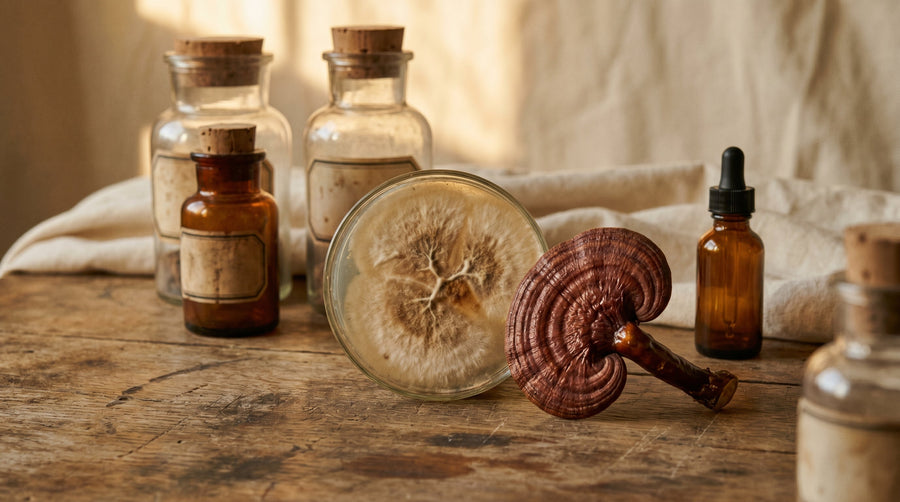
Somewhere in the world right now, an intensive care unit is giving someone a medicine that was discovered in a fungus. Across every shift, in every hospital, on every continent: antibiotics, immunosuppressants, cholesterol drugs. The pills in your grandmother's drawer. The IV drip saving someone's life. Half of the modern medicine cabinet began in a petri dish with something mouldy growing in it.
Most of us don't think about this. We take a pill, trust it works, and don't ask where it came from. But if you traced the most important medicines of the last century back far enough, you'd end up staring at a mushroom.
The first miracle
In 1928, a London bacteriologist named Alexander Fleming came back from vacation to a messy lab. One of his petri dishes was contaminated. A pale green mould called Penicillium notatum had settled in, and the bacteria around it had died.
It could have been thrown out. Fleming looked closer. What he discovered was the first antibiotic: penicillin, produced naturally by a species of fungus. Within two decades it had changed the twentieth century. Before it, a scraped knee could kill you. After it, surgery became routine, childbirth survivable, pneumonia treatable.
Every amoxicillin prescribed at a pharmacy today is a descendant of that mouldy petri dish.
The most prescribed drug on earth
In the 1970s, a Japanese biochemist named Akira Endo was hunting through thousands of fungal cultures looking for a compound that might lower cholesterol. He was working for a pharmaceutical company in Tokyo. After years of failed screens, he isolated compactin, the first statin, from Penicillium citrinum.
It worked.
Today, statins are among the most prescribed drugs on the planet. Over two hundred million people take one daily. Lipitor, Crestor, simvastatin, rosuvastatin. They reduce heart attack and stroke risk, and they extend lives by the millions. All of them trace back to a fungus.
The molecule that made transplantation possible
In 1971, a researcher at Sandoz Laboratories in Basel brought back a soil sample from a hiking trip in Norway. Inside it lived Tolypocladium inflatum, a microscopic fungus. From it, chemists isolated a compound that suppressed the immune system with unprecedented precision.
They called it cyclosporine.
Before cyclosporine, organ transplantation was essentially experimental. The body would reject nearly every transplanted kidney, heart, or liver. After cyclosporine was approved by the FDA in 1983, survival rates leapt. Hundreds of thousands of people have received transplants since. Every one of them owes their life, at least in part, to a fungus in Norwegian dirt.
A pattern, not a coincidence
Penicillin is not a fluke. Statins are not a fluke. Cyclosporine is not a fluke.
The kingdom of fungi has also given us griseofulvin for fungal infections, mycophenolate for transplant recipients, lovastatin, pravastatin, simvastatin. The list keeps going. Researchers have long noticed that fungi, whether moulds, yeasts, or mushrooms, are an unusually rich source of compounds that do interesting things to the human body.
There is a reasonable biological explanation for that. Fungi have been on Earth for roughly a billion years, evolving in competition with bacteria, in chemical conversation with plants, and in soils dense with other organisms. Over that span they've accumulated a large inventory of bioactive molecules that they use to defend themselves, communicate, and interact with the organisms around them. Our own physiology also shares more common ancestry with fungi than most people realise. Genetically, humans are closer to a mushroom than a mushroom is to a plant.
A billion years of evolution doesn't produce accidents.
So when we study fungi, we're rummaging through a pharmacy that took a billion years to fill.
What we've barely looked at
Here's the thing. We've only been doing that rummaging seriously for about a hundred years. And we've mostly been looking at moulds.
The mushrooms humans have been using for thousands of years, like reishi, lion's mane, chaga, turkey tail, and cordyceps, have barely been touched by modern research compared to their fruiting body cousins in a pharmaceutical screening library. Traditional Chinese Medicine has used reishi for over two thousand years. Lion's mane appears in Chinese and Japanese medicine going back more than a thousand. These are not new ideas.
The studies now catching up are catching up to a very old practice. And they keep finding things. Hericenones and erinacines in lion's mane that stimulate nerve growth factor. Triterpenes in reishi that modulate inflammation. Beta glucans across the functional species that interact with the immune system in sophisticated, meaningful ways.
It's early science, not settled science. But the pattern is there. The same pattern that gave us penicillin and statins and cyclosporine.
Why this matters for what we make
We won't tell you reishi will cure your disease or lion's mane will make you smarter. Nobody honest will. Those aren't the right questions.
The right question is this. Given what we already know about fungi, and given how generous this kingdom has been with the medicines we take for granted, does it make sense to dismiss the mushrooms we haven't studied enough yet?
We don't think so.
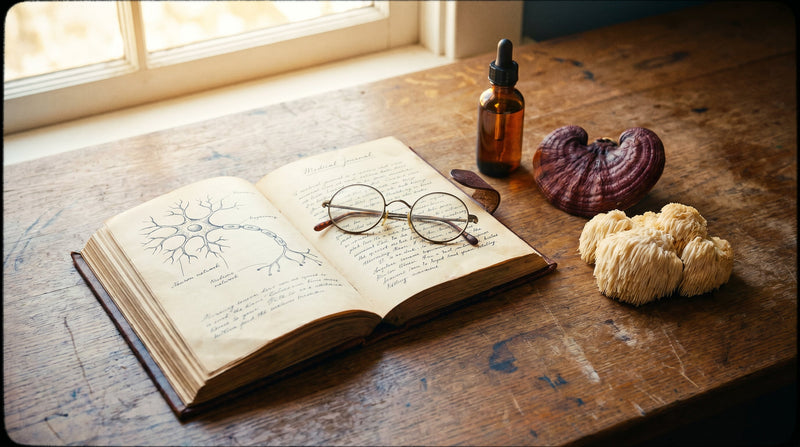
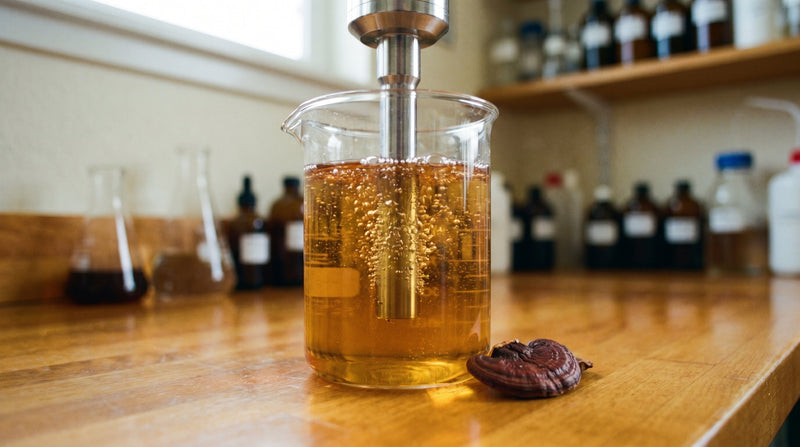
We grow reishi and lion's mane ourselves, on our farm in Kamouraska. Our extraction is cold and uses both water and ethanol, which keeps the full spectrum of compounds intact. We test every batch. We're small, and the elixir is simple: two mushrooms, one bottle, used as a daily ritual.
But the reason we started this brand is the same reason you might consider it yourself. A billion years of evolution doesn't produce accidents. The medicines we already rely on came from fungi. The medicines we'll rely on in fifty years are probably already out there, growing quietly on a fallen tree, in the dark of a forest floor, waiting to be noticed.
We're paying attention.