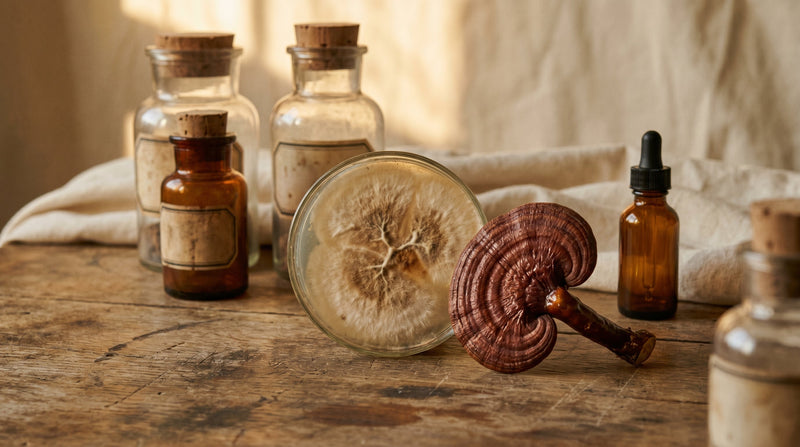
Most mushroom tinctures on shelves today are made with one of two traditional methods. Hot water extraction, which involves boiling the mushrooms for hours. Or alcohol extraction, which involves soaking them for weeks in high proof ethanol. Both methods are centuries old, and both have real tradeoffs that show up in what the bottle can actually do for you.
A mushroom is a split library
A reishi fruiting body contains two important families of bioactive compounds. Beta glucans, which are polysaccharides soluble in water, interact with the immune system and make up the bulk of what researchers call reishi's modulating effects. Triterpenes, which are soluble in oils and ethanol, are responsible for its calming and adaptogenic character. Lion's mane has its own split catalog. Beta glucans on the water side. Hericenones and erinacines on the oil side, both of which cross into the brain and support nerve growth factor.
A traditional tincture made with one solvent only pulls one half of this library. Water extraction misses the triterpenes. Alcohol extraction misses most of the polysaccharides. The best traditional protocols used both in sequence, but the process took weeks and the yield was never reliable.
What heat does
Then there's the temperature problem. Hericenones, which are among the most studied compounds in lion's mane, start degrading at temperatures above roughly 50 degrees Celsius. Boiling water is 100 degrees. Most hot water extractions sit at boiling or just below for two to six hours. By the time the liquid has pulled its polysaccharides, a significant portion of the neurotrophic compounds has cooked off. You end up with something that has the right color and the right mushroom flavor but much less of the bioactive content than the label implies.
Triterpenes tolerate heat better, but they still suffer in long hot extractions. The oldest brewing traditions addressed this by keeping temperatures low and times short, but that reduced yield. The brands producing the most mushroom extract on the market today have mostly optimized for yield, not preservation.
How ultrasonic extraction works
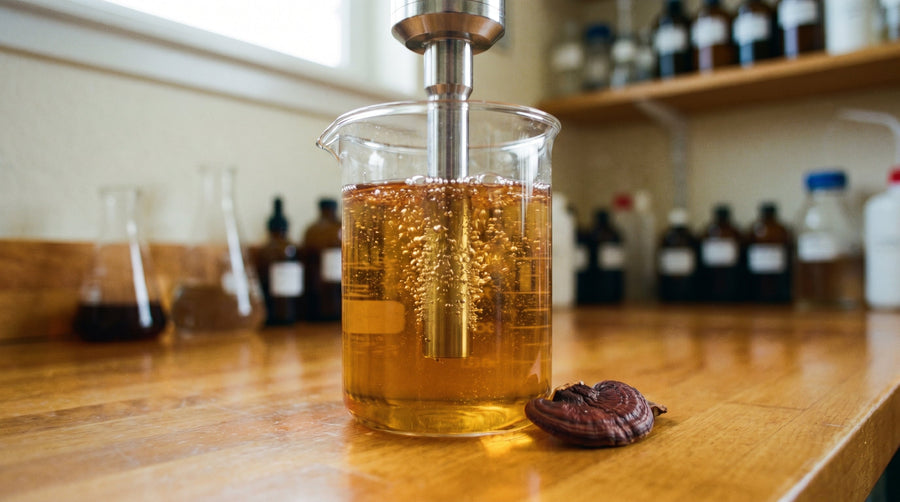
Ultrasonic extraction uses a different principle. A transducer sends sound waves through the liquid at frequencies well above human hearing. These waves create microscopic zones of alternating high and low pressure, a phenomenon called cavitation. The pressure differences physically rupture the fungal cell walls from the inside. The cells pop open instead of getting cooked apart.
Two big implications. First, the extraction is mechanical, not thermal, so it happens in minutes instead of hours. Second, the liquid temperature never needs to rise above about 40 degrees Celsius to get full cell rupture. The compounds vulnerable to heat survive intact.
When you pair ultrasonic extraction with two solvents in sequence, first a water phase, then an ethanol phase, you pull both chemistry families in one process. Full spectrum. Cold. Fast.
Why it matters in the bottle
For someone using a mushroom elixir daily, the difference between an extract damaged by heat and a cold extract shows up in what you actually feel. The focus and clarity effects from lion's mane come from hericenones and erinacines. If heat has reduced those by half during processing, the bottle contains half the functional dose even if the label and price say otherwise. The calm and sleep support from reishi come from specific triterpenes. Same story.
Two bottles with identical ingredient lists can feel very different. Extraction quality is invisible on a label. It shows up only in the experience.
What we do
We built our extraction setup in Kamouraska ourselves. Stainless steel ultrasonic reactor, thermocouples for continuous temperature monitoring, dual solvent system, small batch production. Every batch is made in volumes small enough that we keep tight control over temperature and timing. We test each batch for polysaccharide and triterpene concentration before it goes into bottles. Anything that doesn't hit spec gets discarded.
The technology is not new. Pharmaceutical labs have used ultrasonic extraction for decades. What is new is that the equipment has become accessible enough for small producers to use it. Most traditional mushroom brands have not invested in it yet. That will change over the next five years.
In the meantime, a cold ultrasonic dual extraction is what separates an elixir that reliably works from one that mostly does not. It costs more to produce. The batches are smaller. The yields are lower than hot extraction. But the bottle that ends up on your counter contains everything the mushroom was trying to give you, which was the point in the first place.